From Manners to Rules: Advocating for Legalism in South Korea and Japan

From Manners to Rules traces the emergence of legalistic governance in South Korea and Japan. While these countries were previously known for governance characterized by bureaucratic discretion and vague laws, activists and lawyers are pushing for a more legalistic regulatory style. Legalism involves more formal, detailed, and enforceable rules and participatory policy processes. Previous studies have focused on top-down or structural explanations for legalism. From Manners to Rules instead documents bottom-up sources of institutional and social change, as activists and lawyers advocate for and use more formal rules and procedures. By comparing recent reforms in disability rights and tobacco control, the book uncovers the societal drivers behind legalism and the broader judicialization of politics in East Asia’s main democracies. Drawing on 120 interviews and diverse sources, From Manners to Rules challenges the conventional wisdom that law and courts play marginal roles in Korean and Japanese politics and illuminates how legalistic governance is transforming citizens’ options for political participation.
This book is part of Cambridge’s Studies in Law and Society.
Rights Claiming in South Korea (co-edited with Patricia Goedde)
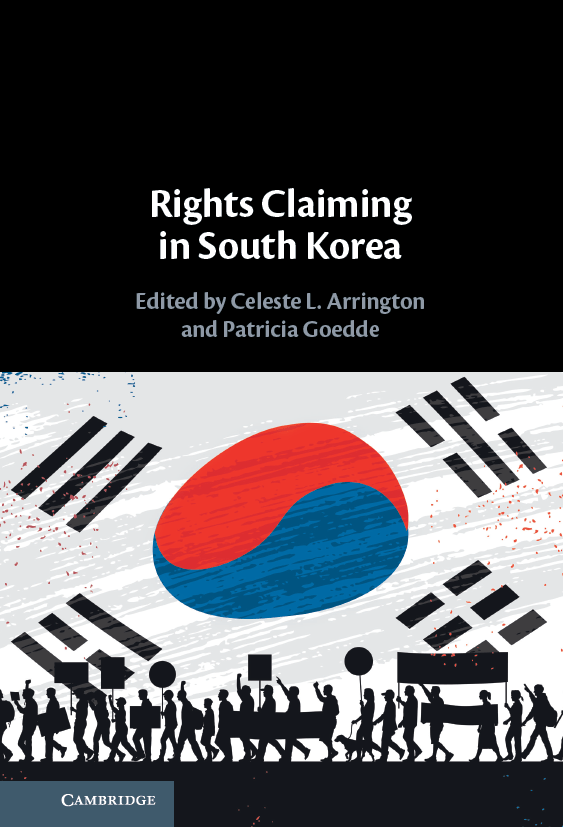
Although rights-based claims are diversifying and opportunities and resources for claims-making have improved, obtaining rights protections and catalyzing social change in South Korea remain challenging processes. This volume examines how different groups in South Korea have defined and articulated grievances and mobilized to remedy them. It explores developments in the institutional contexts within which rights claiming occurs and in the sources of support available for utilizing different claims-making channels. Drawing on scores of original interviews, readings of court rulings and statutes, primary archival and digital sources, and interpretive analysis of news media coverage in Korean, this volume illuminates rights in action. The chapters uncover conflicts over contending rights claims, expose disparities between theory and practice in the law, trace interconnections among rights-based movements, and map emerging trends in the use of rights language. Case studies examine the rights of women, workers, people with disabilities, migrants, and sexual minorities.
Accidental Activists: Victim Movements and Government Accountability in Japan and South Korea

Government wrongdoing or negligence harms people worldwide, but not all victims are equally effective at obtaining redress. In Accidental Activists, Celeste L. Arrington examines the interactive dynamics of the politics of redress to understand why not. Relatively powerless groups like redress claimants depend on support from political elites, active groups in society, the media, experts, lawyers, and the interested public to capture democratic policymakers’ attention and sway their decisions. Focusing on when and how such third-party support matters, Arrington finds that elite allies may raise awareness about the victims’ cause or sponsor special legislation, but their activities also tend to deter the mobilization of fellow claimants and public sympathy. By contrast, claimants who gain elite allies only after the difficult and potentially risky process of mobilizing societal support tend to achieve more redress, which can include official inquiries, apologies, compensation, and structural reforms. Arrington draws on her extensive fieldwork to illustrate these dynamics through comparisons of the parallel Japanese and South Korean movements of victims of harsh leprosy control policies, blood products tainted by hepatitis C, and North Korean abductions. Her book thereby highlights how citizens in Northeast Asia—a region grappling with how to address Japan’s past wrongs—are leveraging similar processes to hold their own governments accountable for more recent harms. Accidental Activists also reveals the growing power of litigation to promote policy change and greater accountability from decision makers.
 Celeste Arrington